Discover Malta
Explore Top Localities
From the bustling streets of Sliema to the historic charm of Valletta, explore our comprehensive guides to find your perfect neighborhood in Malta and Gozo.

Attard
Central
Attard is located in the center of Malta and forms part of the 'Three Villages' alongside Balzan and Lija. It is famous for its quiet, elegant character and large gardens. The official residence of the President of Malta, San Anton Palace, is located here. Walking through Attard feels like traveling back in time with its narrow winding alleys, historic limestone walls, and grand townhouses. It is the premier choice for families looking for peaceful community living in Malta.
4.4 / 5
Very High
Explore Attard

Balzan
Central
Balzan is the smallest of the Three Villages and, in the view of many long-term Malta residents, the most genuinely charming. Citrus trees line some of the older streets, the pace is unhurried, and the sense that you're in an actual village — rather than a suburb that used to be a village — remains intact in a way that's increasingly rare in central Malta. It's the kind of place where you find out about available rentals through word of mouth rather than property portals, because the stock is limited and the turnover is low. People who rent in Balzan tend to stay. That's either a recommendation or a warning, depending on what you're looking for.
4.3 / 5
Very High
Explore Balzan

Birgu
Southern Harbour
Birgu (Vittoriosa) is the oldest of the legendary Three Cities flanking the Grand Harbour. With its historic stone bastions, Fort St Angelo, world-class superyacht marina, and cobbled alleys adorned with flowering bougainvillea, Birgu is a magical blend of Maritime history and luxury living.
4.9 / 5
Very High
Explore Birgu

Birkirkara
Central
Birkirkara, commonly known as B'Kara, is one of Malta's largest and most historic inland towns. It represents a fantastic option for those seeking spacious living spaces and authentic Maltese neighborhood life without the steep prices of the coast. Birkirkara features a beautiful old core centered around the grand St. Helen's Basilica, as well as modern, fast-growing residential developments.
3.7 / 5
High
Explore Birkirkara

Birzebbuga
South Eastern
Birżebbuġa is a vibrant seaside town located in the south of Malta, famed for the sandy shores of Pretty Bay, traditional fishing boats, and historic archaeological landmarks such as Għar Dalam cave. It is an affordable, authentic coastal haven for families and water sports enthusiasts.
4.3 / 5
High
Explore Birzebbuga

Bugibba
Northern
Buġibba (pronounced Boo-JIB-ba) is where a large chunk of Malta's British expat and retiree community ends up, and there are good reasons for it. The waterfront promenade stretches for kilometres, the Malta National Aquarium sits at one end, the square has enough bars and restaurants to cover any mood, and the rents are a fraction of what you'd pay in Sliema for an equivalent flat. It's not a glamorous address — the architecture is functional resort-town fare, and the area carries a reputation as the most 'British abroad' corner of Malta. That's precisely the appeal for some people, and not at all appealing for others. The practical calculation is straightforward: waterfront living, decent amenities, and rents starting around €550 for a one-bedroom, at the cost of a 40-minute bus ride to Valletta.
3.6 / 5
High
Explore Bugibba

Central Business District
Central
4.0 / 5
High
Explore Central Business District

Floriana
Central
Floriana is the town that stands between Valletta and the rest of Malta — a buffer zone in the best sense, with a character and identity of its own. The Granaries, Sa Maison Gardens, the Mall, and the long green stretch of the Argotti Botanic Gardens give Floriana more public space per resident than almost anywhere else on the island, which is an unusual distinction in a country where green space is scarce. It's also the most affordable address in the direct harbour area. The commute to Valletta is ten minutes on foot or a few minutes by bus. The ferry to Sliema runs from the adjacent waterfront. The quality of the residential stock varies considerably — from restored character townhouses to functional older apartments — but the location is genuinely excellent for the prices, which consistently undercut both Valletta and Sliema.
3.9 / 5
High
Explore Floriana

Gharghur
Northern
Għargħur is one of Malta’s most picturesque and elevated hilltop villages, renowned for its peaceful ambiance, traditional limestone architecture, and the famous Top of the World panoramic lookout over the Mediterranean. It offers a tranquil village lifestyle just 7 minutes from Naxxar and Madliena.
4.8 / 5
Very High
Explore Gharghur

Gzira
Central-East
Gzira has quietly become one of Malta's smartest rental choices for people who want the harbour-front lifestyle without paying Sliema prices for it. The view is the same — Valletta's limestone skyline sitting across Marsamxett — and the distance from Sliema's shops is around ten minutes on foot. The price difference, though, is consistently 20–30%. The Strand in Gzira has improved significantly in recent years. Lidl, Scott's, a growing café scene, and the National Pool give it genuine day-to-day substance. Manoel Island, just across the short bridge, has been the subject of a major redevelopment project that will eventually add hotels, residences, and a marina — meaning Gzira is one of the areas in Malta where the trajectory is clearly upward.
4.1 / 5
High
Explore Gzira
Hamrun
Central
Ħamrun is a bustling, energetic commercial and cultural hub in central Malta. Famous for its long retail high street (St Joseph High Road), rich chocolate festival traditions, and affordable central housing, Ħamrun provides exceptional day-to-day convenience.
4.3 / 5
High
Explore Hamrun

Iklin
Central
Iklin is a small suburban town in the hills between Naxxar and San Gwann, and it's the kind of place that gets overlooked in favour of its better-known neighbours. That's not entirely unfair — Iklin doesn't have a beach, a landmark, or a particularly memorable town centre. What it does have is clean air from the elevated position, good road access in all directions, quiet streets, and modern housing stock at prices that reflect the lack of profile rather than the lack of quality.
3.8 / 5
Very High
Explore Iklin
Kalkara
Southern Harbour
Kalkara is a peaceful, charming coastal village situated in the Grand Harbour, wrapping around Kalkara Creek right between Birgu and the smart tech enclave of SmartCity Malta. Known for Villa Bighi and Fort Ricasoli, it combines village warmth with coastal calm.
4.5 / 5
Very High
Explore Kalkara

Lija
Central
Lija is the third of the Three Villages — and the one most people in Malta will tell you is the most beautiful. The streets are extremely narrow, the gardens visible over the high walls of old houses are extraordinary, and the annual festa fireworks display is, without genuine exaggeration, one of the most spectacular in a country that takes its fireworks more seriously than almost anywhere else. The residential character is exclusive. Properties in Lija's historic core rarely come to market, and when they do, they don't stay available for long. It's a town for people who've been in Malta for years, who know someone who knows someone. The village feel is intact in a way that even Balzan, next door, has slightly lost.
4.5 / 5
Very High
Explore Lija

Marsalforn
Gozo
Marsalforn is Gozo's most popular seaside village and its most internationally visited corner. The bay itself is horseshoe-shaped, with the sea in a colour that photographs end up looking oversaturated even though they're accurate. The famous salt pans stretch west along the coast — geometric pools cut into the limestone centuries ago and still harvested — and the Qbajjar bay extends east, where some of the island's clearest waters are. The resident population is small and year-round, though it swells considerably in summer when the beach bars open and Maltese families take their summer houses here. Winter is the other side of that equation: quieter, more austere, and genuinely beautiful in a way that the summer crowds obscure.
4.3 / 5
Very High
Explore Marsalforn

Marsaskala
South-East
Marsaskala (or Marsascala — both spellings are used) is a U-shaped bay town on the southeast coast of Malta, and it has a reputation among expats who know the island well as one of the most liveable places on it. The bay is sheltered, the promenade curves around it to St Thomas Bay, the fishing boats are colourful and genuinely used, and the atmosphere manages to feel like a real Maltese town rather than a resort. The expat community here is smaller and more settled than in Buġibba or the northern towns — people who came for a month or two and are still here five years later tend to cluster in Marsaskala. The airport is fifteen minutes by car, the commute to Valletta is around thirty minutes, and the weekend fish market in nearby Marsaxlokk is one of the better reasons to own a car in southern Malta.
4.1 / 5
Very High
Explore Marsaskala
Marsaxlokk
South-East
Marsaxlokk is Malta's most famous fishing village, and it earns the description without any caveats. The harbour is lined with brightly painted luzzu — the traditional Maltese fishing boats with painted eyes on the prow — and the Sunday market that runs along the waterfront is the best reason to be in southern Malta on a weekend morning. Fresh fish from the boats, local produce, household goods, and the kind of organised cheerful chaos that makes a good market. The village is small and predominantly Maltese in character. Expats who live here tend to be people who have specifically chosen authenticity over convenience, and who have a car. The commute to Valletta is around 35 minutes, and the amenities within the village are limited. But the setting — the harbour, the fishing community, the quality of the seafood restaurants on the waterfront — is one of the most characterful in the Maltese Islands.
4.2 / 5
Very High
Explore Marsaxlokk

Mdina
Western
Mdina, the "Silent City", is Malta’s ancient medieval capital. Perched high on an inland plateau with sweeping panoramic views across the island, Mdina is an open-air museum of noble palazzos, lantern-lit alleys, and timeless tranquility.
4.9 / 5
Exceptional
Explore Mdina

Mellieha
Northern
Mellieħa sits at the northern tip of Malta, perched on a ridge with views that stretch down to the island's best sandy beach on one side and across the countryside toward the Gozo Channel on the other. It's the most scenic town on the main island by a fair margin, and the lifestyle reflects that: slower, more outdoor-focused, less traffic. The expat community here skews older than in the harbour towns — retirees, remote workers, and families who have made a deliberate choice to trade commute time for quality of life. The Gozo Ferry at Ċirkewwa is ten minutes away, which makes weekend trips to Gozo easy enough to become a habit. The commute to Valletta is a genuine 45–50 minutes, which is the honest reality that anyone considering Mellieħa should account for before signing a lease.
4.2 / 5
Very High
Explore Mellieha

Mosta
Northern
Mosta is a bustling, historic town in central Malta, famous for its magnificent Rotunda of Mosta, which boasts one of the largest unsupported church domes in the world. The town is a vibrant blend of traditional Maltese heritage and modern commercial activity. With its central location, Mosta provides easy access to all parts of the island, making it highly popular for families and professionals seeking a lively, authentic community.
4.0 / 5
Very High
Explore Mosta
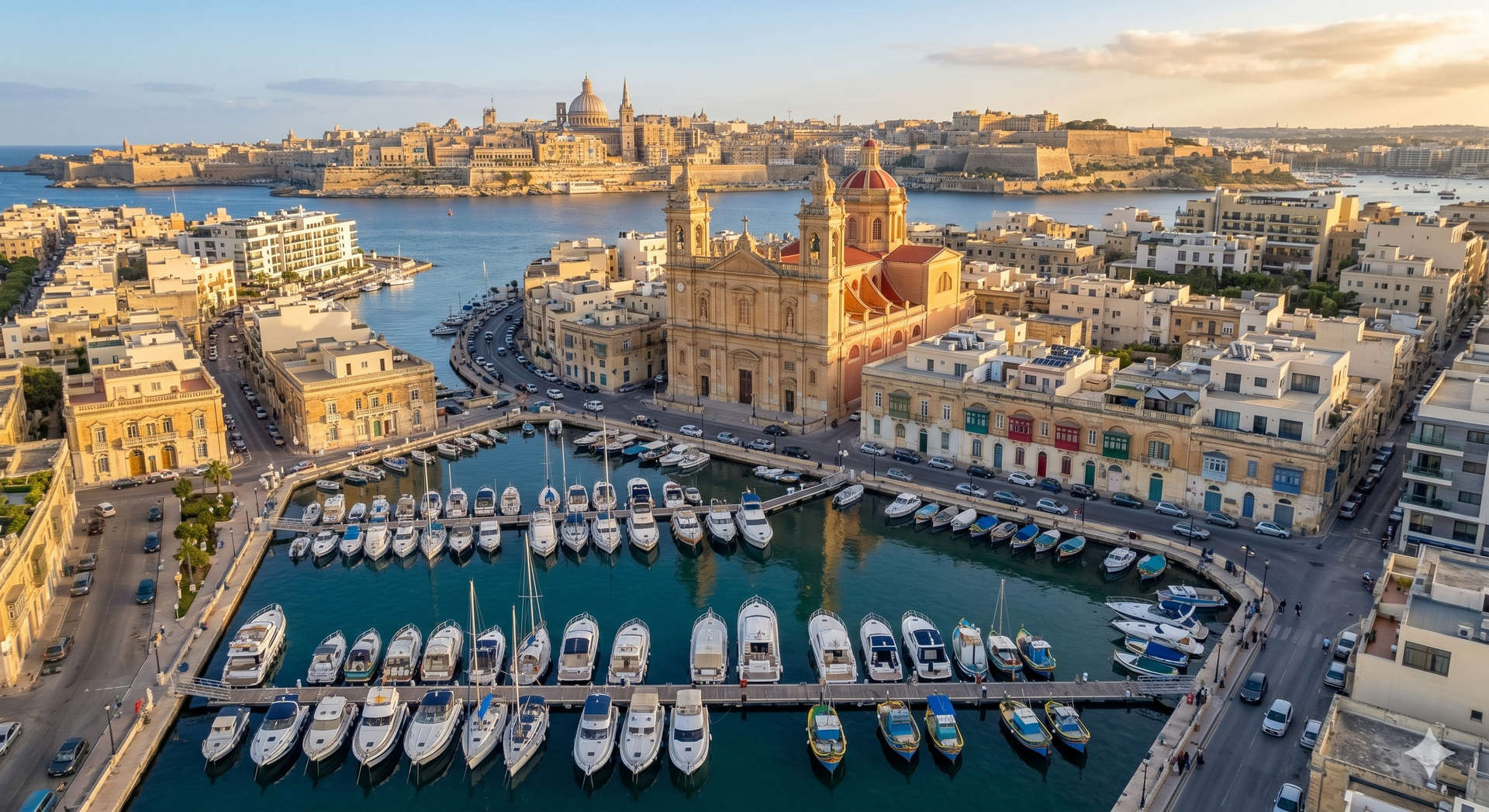
Msida
Central
Msida is a vibrant harbor town situated around a busy yacht marina, serving as a key gateway in Malta. Home to the University of Malta and the Junior College, Msida is a bustling student hub and a highly popular residential area for young professionals and academics. Its marina offers scenic walks, and its central location makes commuting to Valletta or Sliema incredibly quick and convenient.
3.8 / 5
High
Explore Msida
Naxxar
Northern
Naxxar's old core, centred on Victory Square and the impressive parish church, gives way in all directions to more recent residential development — a mix that characterises many of Malta's larger inland towns. What makes Naxxar stand out is Palazzo Parisio, one of the island's most beautiful Baroque palaces, which sits behind high walls on the main road and regularly hosts events that draw people from across Malta. Beyond the architecture, the town has grown into a genuinely practical family base. The MFCC trade fair complex, on the northern edge of the town, hosts concerts, fairs, and major events throughout the year. Schools are well-regarded. Property tends to be spacious relative to the price. And the commute to Valletta, while not short, is manageable by Maltese standards.
3.9 / 5
Very High
Explore Naxxar

Pembroke
Central-East
Pembroke is a relatively modern residential town on the northeastern coast of Malta, built largely on what were formerly British military barracks. The fortifications, parade grounds, and military architecture are still visible in the existing buildings, giving parts of the town an unusual atmosphere — orderly, spacious, and unlike anywhere else on the island. The coastline here is different from the southern harbour — exposed rock platforms, a wilder sea, and clear water without the density of boats. The Pembroke coastline walk connects to St George's Bay and Paceville on one side and to White Rocks and Baħar iċ-Ċagħaq on the other. For families with children, the combination of quiet streets, the SKOLA school complex, and the proximity to St Julian's is a compelling offer.
3.9 / 5
Very High
Explore Pembroke

Pieta
Central-East (Harbour)
Pietà (including Gwardamanġa) is a historic seaside and marina suburb situated along Msida Creek, right between Msida, Floriana, and Valletta. Boasting picturesque waterfront promenades filled with yachts, elegant colonial villas, and immediate walking proximity to the capital and St Luke’s tech/business zones, Pietà is a premier residential choice for doctors, gaming professionals, and commuters desiring central harbour living with lower rent than Sliema.
4.6 / 5
High
Explore Pieta

Qormi
Central
Qormi — or Il-Qormi — is known across Malta as the bread town. The bakery tradition here goes back centuries, and the smell of freshly baked Maltese hobż on a weekday morning is a genuine part of the local experience. The town received city status some time ago, though it still feels and functions like a large traditional village rather than a city in any conventional sense. It's an honest, unpretentious place. Rents are among the more affordable in the central belt, the community is predominantly Maltese (it's not an expat hub), and the location is solid: close to the airport, accessible to Valletta, and well-positioned on the main road network. For people relocating to Malta for work rather than lifestyle, Qormi makes a sensible base that doesn't require paying coastal premiums.
3.5 / 5
High
Explore Qormi
Rabat
Central
Rabat sits immediately outside the walls of Mdina — the Silent City — and was historically the suburb that served the fortified hilltop town. Today the relationship is reversed in practice: Rabat is the larger town, with a proper range of local amenities, while Mdina functions primarily as a tourist and heritage site with a tiny permanent population. The combination of the two is one of the most historically rich living environments in Malta. The Roman Villa, the catacombs of St Paul and St Agatha, the churches, and the winding streets of both Rabat and Mdina are on the doorstep. Restaurants, including some of Malta's better ones, have settled into the streetscape here. The pace is unhurried, the streets are quieter than the coastal towns, and the hill position gives Rabat air and views that the harbour towns don't have.
4.1 / 5
Very High
Explore Rabat

San Gwann
Central
San Gwann is the kind of town that doesn't get written about much, which is a shame because it solves a specific problem very well: how do you find a central base in Malta that doesn't cost Sliema money and doesn't require living somewhere with no nearby facilities? The answer is a town with decent supermarkets, good road access in all directions, reasonable rents, and a growing stock of modern apartments that developers discovered about a decade ago. It's not a scenic town — there's no sea view and no historic centre worth visiting — but the commute to Sliema is eight minutes by car, Valletta fifteen, and the airport twenty. For people who spend their time elsewhere and want somewhere sensible to come home to, San Gwann is underrated.
3.7 / 5
High
Explore San Gwann

Sannat
Gozo
Sannat is a small hilltop village on the southern tip of Gozo, and its defining feature is the Ta' Ċenċ plateau — a flat expanse of limestone clifftops above the sea that is, by a reasonable argument, the most dramatic landscape in the Maltese Islands. The cliffs drop vertically into the water, the plateau stretches out flat and bare, and on the right evening the light does something to the stone that rewards anyone who makes the effort to be there. The Ta' Ċenċ Hotel, one of Gozo's better-regarded properties, sits at the edge of the plateau. The village itself is small, quiet, and entirely without pretension. It suits remote workers, writers, retirees, and anyone whose primary requirement of a home is that it be genuinely peaceful.
4.2 / 5
Very High
Explore Sannat
Santa Venera
Central
Santa Venera is a thriving central suburb located directly between Birkirkara and Ħamrun. Centered around the historic Wignacourt Aqueduct and Romeo Romano Gardens, it offers unbeatable central logistics, affordable rents, and close proximity to corporate offices.
4.4 / 5
High
Explore Santa Venera
Siggiewi
Western
Siġġiewi is an ancient rural municipality in the south-west of Malta, set against fertile valleys, the dramatic cliffs of Għar Lapsi, and the historic Inquisitor’s palace. It represents the quintessential Maltese agrarian countryside while sitting just 15 minutes from the airport and central hubs.
4.6 / 5
Very High
Explore Siggiewi

Sliema
Central-East
Sliema is Malta's premier cosmopolitan coastal hub, blending high-end retail, waterfront dining, and modern apartment living. Stretching along a beautiful rocky coastline, Sliema features a popular waterfront promenade that is alive day and night. It is the business and social center for expats and locals alike, offering stunning views across the water to Valletta's fortifications. Sliema offers an exciting, fast-paced Mediterranean urban lifestyle.
4.6 / 5
Very High
Explore Sliema

St Julians
Central-East
St. Julian's, or San Ġiljan, is Malta's ultimate coastal entertainment, dining, and lifestyle destination. Centered around the picturesque Spinola Bay and the luxury Portomaso Marina, St. Julian's is a dynamic seaside town that never sleeps. It blends traditional colorful fishing boats (Luzzus) with soaring modern towers, top-tier international businesses, and a world-class culinary scene, attracting global expats and travelers.
4.4 / 5
High
Explore St Julians

St Paul's Bay
Northern
St Paul's Bay, which encompasses the areas of Bugibba and Qawra along the northern coastline, is the largest resort town in Malta and one of the island's most established expat communities. The name comes from the shipwreck of St Paul in 60 AD — an event that is taken seriously enough locally to appear on the town's coat of arms. The appeal is consistent: a long promenade, affordable rents by Maltese standards, year-round community life, and a settled British expat population that has been here long enough to know where to get the good fish and chips and where to find the best fresh fish market. It's more lived-in than glamorous, and most residents would consider that a point in its favour.
3.8 / 5
High
Explore St Paul's Bay

Swieqi
Central-East
Swieqi is an upscale, quiet residential suburb situated on the hills just behind St Julian's. It offers a perfect balance: the peaceful security of a family neighborhood, combined with immediate access to the entertainment and business districts of the coast. Swieqi is highly sought after by expat families, corporate professionals, and diplomats due to its premium housing stock and proximity to top international schools.
4.3 / 5
Very High
Explore Swieqi
Ta Xbiex
Central-East
Ta' Xbiex is one of those places that people in Malta know about but not everyone has actually lived in. The town is genuinely tiny — a walk from one end to the other takes around eight minutes — and it's wedged between Msida, Gzira, and Pietà in a way that gives it access to all three without fully belonging to any of them. The marina is the defining feature. Yachts line the waterfront year-round, and several foreign embassies occupy the better-maintained houses on the main road, giving the whole area a quietly diplomatic character. Sunrises over the Grand Harbour from the waterfront promenade are, by any reasonable measure, exceptional. Rents reflect the premium, and availability is limited simply because the town isn't very big.
4.2 / 5
Very High
Explore Ta Xbiex

Tarxien
South
Tarxien is a southern Malta town that carries a historical weight entirely disproportionate to its size. The Tarxien Temples — a UNESCO World Heritage Site and one of the most significant prehistoric complexes in the world — sit in the middle of a residential neighbourhood, which is either completely ordinary to the people who've lived here all their lives or quietly astonishing to anyone encountering it for the first time. For practical purposes, Tarxien's main advantage is proximity: ten minutes to the airport, twenty-five to Valletta, and a short drive to the southern beaches at Marsaxlokk and the Blue Grotto. Rents are reasonable, the community is quiet and predominantly local, and the airport convenience is a genuine selling point for anyone who travels frequently for work.
3.6 / 5
Very High
Explore Tarxien
Valletta
Central
Valletta is, by a reasonable margin, the most interesting place to live in Malta. The entire city is a UNESCO World Heritage Site — 320 monuments in an area smaller than many housing estates — and the residential experience reflects that. You're not just renting a flat; you're living inside a 16th-century Baroque city that the Knights of St John built from scratch, stone by stone, on a bare peninsula. The character of the city has shifted noticeably since its stint as European Capital of Culture in 2018. A generation of young Maltese and expats who would previously have looked straight at Sliema now choose a converted palazzo in Valletta, drawn by the creative scene on Strait Street, the rooftop terraces, and the genuine sense that something is happening here. The practicalities are real though: hills and steps are everywhere, parking doesn't really exist within the walls, and the quietest nights outside summer can feel like the city has gone home. But for the right person, none of that matters.
4.7 / 5
Very High
Explore Valletta

Victoria (Rabat Gozo)
Gozo
Victoria — known in Maltese as Rabat and to most Gozitans simply as 'il-Belt' (the town) — is the capital of Gozo in every meaningful sense. Government offices, the main hospital, the best shops, the markets, the restaurants, and the social life of the island all concentrate here. The Cittadella, the fortified hilltop citadel at the centre of the town, is one of the most extraordinary medieval fortifications in the Mediterranean — and on a clear day, the views from the ramparts take in the full sweep of Gozo, Malta, Comino, and the sea beyond. Living in Victoria means living on an island. That's the central reality for anyone considering it: the ferry crossing to Malta is 25 minutes, but the schedule and the weather dictate when you go, and the total journey to Valletta becomes an hour and a half rather than twenty minutes. For remote workers, retirees, or anyone whose work keeps them on Gozo, that's a non-issue. For people commuting daily to Malta, it's significant.
4.4 / 5
Very High
Explore Victoria (Rabat Gozo)
Xaghra
Gozo & Comino
Xagħra is one of the most beloved hilltop towns in Gozo, home to the UNESCO World Heritage Ġgantija Temples, Ramla Bay’s red sand, and a vibrant village square with outstanding restaurants. It is a top choice for expats and retirees on the sister island.
4.8 / 5
Exceptional
Explore Xaghra

Xlendi
Gozo
Xlendi is a small fishing hamlet on Gozo's southwest coast, enclosed on three sides by dramatic limestone cliffs and open on the fourth to a turquoise bay that justifies every superlative directed at it. The village is tiny — the full length of the promenade takes five minutes to walk — and the year-round population is small enough that everyone knows everyone. It's the kind of place that people visit for a day, then come back to live. The combination of the physical setting, the quality of the seafood restaurants on the waterfront, and the evening atmosphere — particularly in late spring and autumn, when the tourists have thinned but the weather holds — is genuinely difficult to replicate elsewhere in the Maltese Islands.
4.6 / 5
Very High
Explore Xlendi
Zurrieq
South Eastern
Żurrieq is one of Malta’s oldest and most scenic southern towns, famed globally for the iconic Blue Grotto sea caverns and ancient mill heritage. It combines traditional limestone village architecture with open Mediterranean coastal expanses.
4.7 / 5
Very High
Explore Zurrieq